

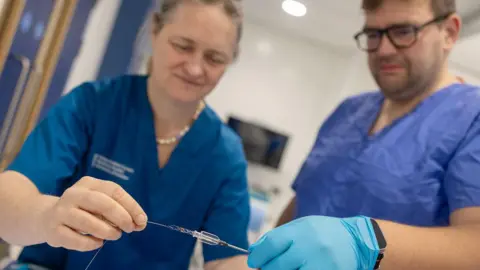
Doctors from the Scottish region and the United States have performed what is thought of as a world-first stroke surgery employing robotic technology.
The medical expert, from a Scottish university, conducted the remote thrombectomy - the elimination of vascular blockages post a stroke - on a human cadaver that had been donated to medical science.
The surgeon was working from a medical facility in the Scottish city, while the specimen being treated with the device was separately situated at the academic institution.
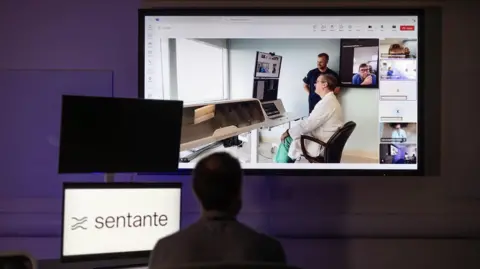
Later that day, a neurosurgeon from the US location utilized the technology to conduct the pioneering long-distance operation from his American facility on a donated cadaver in Dundee over 4,000 miles away.
The research collective has described it as a potential "revolutionary development" if it gains clearance for clinical application.
The doctors consider this system could change stroke care, as a limited availability of expert care can have a significant effect on the recovery prospects.
"It seemed like we were seeing the early preview of the coming era," commented Prof Grunwald.
"Whereas before this was regarded as science fiction, we proved that all stages of the surgery can currently be accomplished."
The University of Dundee is the worldwide teaching facility of the global medical association, and is the only place in the Britain where surgeons can treat donated bodies with actual blood flowing through the blood pathways to mimic treatment on a actual patient.
"This was the first time that we could conduct the complete clot removal operation in a genuine medical subject to demonstrate that each stage of the operation are achievable," said Prof Grunwald.
A healthcare leader, the chief executive of a health foundation, described the intercontinental surgery as "a significant breakthrough".
"For too long, people living in remote and rural areas have been denied availability to clot removal," she stated.
"This type of automation could rebalance the inequity which occurs in stroke treatment throughout Britain."
How does the system function?
An blockage stroke occurs when an artery is blocked by a blockage.
This interrupts circulation and oxygenation to the brain, and neurons stop functioning and deteriorate.
The optimal therapy is a thrombectomy, where a specialist uses catheters and wires to remove the clot.
But what transpires when a patient is unable to reach a expert who can perform the surgery?
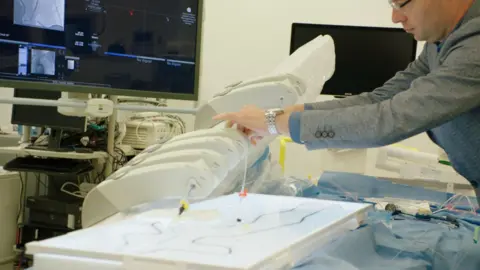
The lead researcher said the experiment showed a automated system could be linked with the equivalent surgical tools a specialist would typically employ, and a healthcare professional who is with the patient could easily connect the wires.
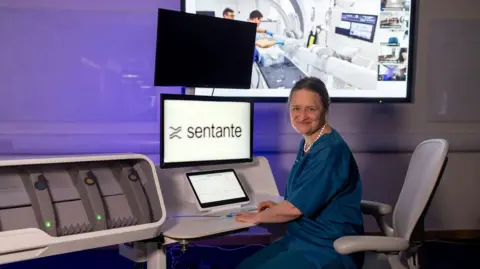
The expert, in another location, could then hold and move their individual tools, and the robot then executes comparable motions in immediate sequence on the patient to carry out the clot removal.
The patient would be in a treatment center, while the specialist could conduct the operation with the automated equipment from any place - even their own home.
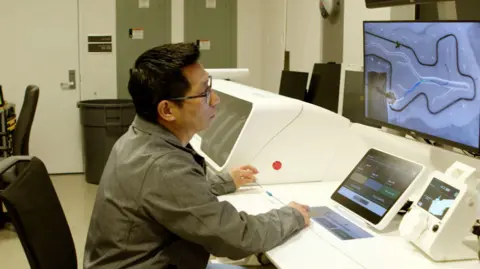
The lead researcher and the American specialist could observe live X-rays of the body in the experiments, and monitor progress in real time, with the Dundee expert explaining it took only 20 minutes of instruction.
Technology companies Nvidia and Ericsson were involved in the research to ensure the communication link of the mechanical device.
"To perform surgery from the America to Scotland with a brief latency - an instant - is genuinely extraordinary," stated the medical expert.
Innovations in cerebral healthcare
The medical expert, who has won an award for her work and is also the senior official of the World Federation for Interventional Stroke Treatment, stated there were key issues with a standard thrombectomy - a worldwide deficiency of surgeons who can conduct it, and care is determined by your geographical position.
In the Scottish nation, there are only three places individuals can access the surgery - Dundee, Glasgow and Edinburgh. If you don't live there, you must commute.
"The intervention is extremely time-critical," stated Prof Grunwald.
"Every six minutes delay, you have a 1% less chance of having a successful recovery.
"This technology would now deliver a innovative method where you're not reliant upon where you live - saving the valuable minutes where your cerebral matter is deteriorating."
Healthcare information revealed there were {9,625 ischaemic strokes|numerous cerebral events|

